
Contents
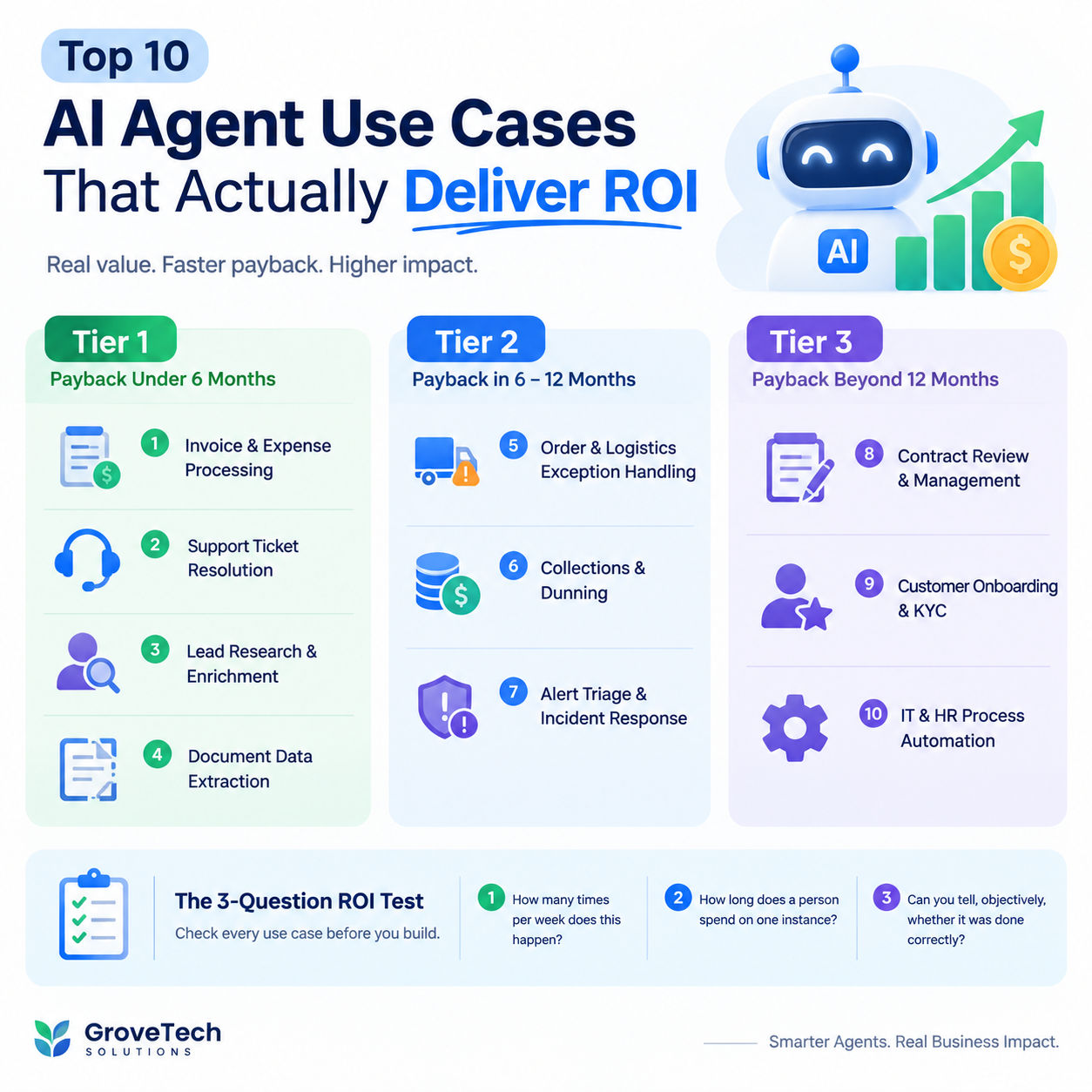
- 01The Three-Question ROI Test
- 02Tier 1: Payback Under 6 Months
- 1. Invoice and Expense Processing
- 2. Support Ticket Resolution
- 3. Lead Research and Enrichment
- 4. Document Data Extraction
- 07Tier 2: Payback in 6 to 12 Months
- 5. Order and Logistics Exception Handling
- 6. Collections and Dunning
- 7. Alert Triage and Incident Response
- 11Tier 3: Payback Beyond 12 Months, Highest Ceiling
- 8. Contract Review and Obligation Tracking
- 9. Compliance Monitoring and Audit Preparation
- 10. Cross-System Data Reconciliation
- 15The ROI Math
- 16What Actually Kills ROI
- 17Why Build With GroveTech Solutions
The question isn't which AI agent use cases work. Plenty do. The question is which ones return money fast enough to fund the next one - because in most organizations, the second agent gets approved only if the first one produced a number somebody could defend in a budget meeting.
That reframes the whole exercise. You're not looking for the most valuable use case. You're looking for the fastest provable one.
This guide ranks ten proven applications by payback speed, based on the pattern we see across AI development projects: the ones that scale are almost never the ambitious ones. They're the narrow ones that paid for themselves before anyone lost patience.
The Three-Question ROI Test
Run every candidate through this before it gets a line item:
- How many times per week does this happen? Under 50, the build cost rarely clears. Over 500, almost any competent implementation wins.
- How long does a person spend on one instance? Under 5 minutes, savings evaporate into oversight overhead. Over 15, the case makes itself.
- Can you tell, objectively, whether it was done correctly? If correctness is a matter of opinion, you cannot evaluate the agent - and an AI agent you cannot evaluate cannot be trusted with autonomy.
Three yeses means build. Two means pilot cautiously. One means find a different workflow.
Tier 1: Payback Under 6 Months
1. Invoice and Expense Processing
The agent ingests invoices and receipts from email or upload, extracts line items, matches them against purchase orders and policy rules, posts clean records, and routes exceptions with the discrepancy already identified.
ROI driver: volume plus unambiguous correctness. Finance already tracks cost per invoice, so the baseline exists before you start. Measure invoices processed per hour, exception rate, and cost per invoice before and after.
2. Support Ticket Resolution
Not deflection - completion. The agent verifies eligibility, executes the refund or replacement across payment and order systems, updates records, and confirms with the customer. This is the same autonomy that separates a true agentic AI system from a scripted response.
ROI driver: tier-1 tickets are repetitive and already measured in cost per contact. Measure full-resolution rate without human touch, average handling time, and escalation quality.
3. Lead Research and Enrichment
For each inbound lead the agent profiles the account, identifies the buying role, checks funding and hiring signals, scores fit, and writes it to the CRM before a rep opens the record.
ROI driver: research is pure overhead on selling time, and the output feeds revenue activity directly - making attribution unusually clean. Measure rep hours reclaimed, speed to first contact, and conversion on enriched versus unenriched leads.
4. Document Data Extraction
KYC packets, claims, shipping documents, application forms. Classify, extract structured fields, validate against business rules, and flag low-confidence results for review.
ROI driver: it eliminates manual data entry rather than assisting it, and accuracy is directly testable against historical records. Measure fields extracted per document, accuracy against ground truth, and review rate. This tier usually needs a sound data engineering foundation first.
Tier 2: Payback in 6 to 12 Months
5. Order and Logistics Exception Handling
Delays, failed address validation, stock shortfalls. The agent detects the exception, diagnoses the cause, evaluates alternatives, executes the fix, and notifies everyone affected.
ROI driver: exceptions consume operations teams disproportionately, and each has a known resolution path that's simply tedious. Why it's slower: more systems to integrate - order management, warehouse management, carrier APIs - which stretches the build. Projects at this stage often lean on custom software development to stitch the systems together cleanly.
6. Collections and Dunning
The agent monitors ageing receivables, sequences reminders by customer risk profile and payment history, drafts context-appropriate messages, logs promises to pay, and escalates genuine disputes.
ROI driver: it moves cash, not just hours. Days-sales-outstanding improvement is a CFO-legible metric. Why it's slower: it requires tone judgment and relationship sensitivity, so it needs more supervised iteration before autonomy.
7. Alert Triage and Incident Response
The agent correlates alerts with logs, traces, and recent deploys, assesses severity, drafts a diagnosis, resolves known patterns, and pages the right engineer with context attached.
ROI driver: it reclaims the most expensive hours in the building and compresses time to resolution. Why it's slower: it demands mature observability to be useful, which is why it fits organizations already running a solid DevOps practice.
Tier 3: Payback Beyond 12 Months, Highest Ceiling
8. Contract Review and Obligation Tracking
The agent reviews incoming contracts against your standard positions, flags deviations by severity, extracts obligations and key dates into a tracker, and surfaces renewal and termination windows before they lapse.
ROI driver: avoided risk and missed-deadline losses, plus meaningful legal review time saved. Why it's slower: high stakes demand extensive human-in-the-loop review before any autonomy is granted.
9. Compliance Monitoring and Audit Preparation
Continuous checking of transactions, communications, or configurations against policy, with evidence documented per exception and audit packages assembled on demand.
ROI driver: penalties avoided and audit preparation compressed from weeks to days. Why it's slower: it requires codifying policies that often exist only as institutional habit.
10. Cross-System Data Reconciliation
Your CRM, billing platform, and product database disagree about who the customer is. The agent compares records, identifies conflicts, applies resolution rules, corrects what it safely can, and escalates the rest.
ROI driver: the cost is currently hidden - bad decisions made on bad data - which makes it the hardest to quantify and often the largest. Why it's slower: it typically surfaces alongside a legacy modernization or cloud migration programme.
The ROI Math
A simple formula for the business case:
Annual saving = (instances per year x minutes per instance / 60) x fully loaded hourly cost x automation rate
Subtract build cost, running cost (tokens, tools, infrastructure), and maintenance. Use a conservative automation rate - 60-70% for a first agent, with the remainder escalating to humans.
Then adjust for what the formula misses. Add errors avoided and cycle time reduced. Subtract oversight cost, because someone reviews the escalations. If the business case only survives at 95% automation, the case doesn't survive.
What Actually Kills ROI
- Scope creep during the build. One workflow. One owner. One metric.
- No pre-build baseline. If you didn't measure the human process first, you cannot prove improvement afterward.
- Ignoring cost per run. Track it from day one; unoptimized agents can cost more than the labor they replace.
- Low-volume workflows. A monthly task saves twelve hours a year against a six-figure build.
- Undocumented processes. Budget disappears into discovery instead of automation.
If your first agent succeeds and the team wants to move fast on the next one, scope it the same way you'd scope a new product: narrow first. Our approach to MVP development applies the same logic to agent rollouts - prove the smallest valuable slice before you build out the rest.
Why Build With GroveTech Solutions
GroveTech Solutions designs and ships AI agents end to end - from the three-question ROI test through discovery, data pipeline, build, evaluation, and deployment, rather than handing over a demo. We've done this across finance, support, sales, and operations workflows, on OpenAI, Claude, and Gemini models with custom orchestration.
Want help identifying and sequencing your use cases? Explore our AI integration and consulting services, see delivered work in our portfolio, browse more guides on the blog, or contact our team for a free consultation.
Frequently Asked Questions
Common questions about Top 10 AI Agent Use Cases That Actually Deliver ROI
Invoice and expense processing, in most organizations. It combines high volume, structured inputs, objectively verifiable output, and an existing cost baseline in finance - which means ROI can be proven within months rather than argued about.
Tier 1 use cases like invoice processing and ticket resolution typically pay back within six months of deployment. Integration-heavy workflows take six to twelve. Compliance and contract use cases often take over a year because of the human review required before autonomy.
Multiply annual task volume by minutes saved per task and fully loaded hourly cost, then apply a realistic automation rate of 60-70%. Subtract build cost, running cost, and oversight. Add the value of errors avoided and faster cycle times.
As a rule of thumb, at least 50 instances per week where each takes a person five minutes or more. Below that, build and oversight costs usually exceed the savings regardless of how well the agent performs.
No - start with the fastest provable one. High-ceiling use cases like compliance monitoring take longest to show returns, and AI programmes rarely survive a year without a defensible result. Prove economics in Tier 1, then reinvest.
Yes, where volume justifies it. A small team processing hundreds of invoices or support tickets monthly can build a solid case; one handling a few dozen usually cannot. Transaction volume matters far more than headcount.
Driven by tokens per run, tool and API calls, and infrastructure. Well-optimized agents typically cost a fraction of the labor they replace, but unoptimized ones can exceed it - which is why cost per completed task should be tracked from the first run.
Yes, through APIs. Where none exist, options include a service wrapper, database-level access, or browser automation. Integration work is usually the largest single cost in an agent project, not the AI itself.
Plan for 60-70% full automation on a first deployment, with the remainder escalating to humans. Rates improve with iteration, but any business case that requires near-total automation to work is too fragile to fund.
Almost always scope - an ambiguous, low-volume, or undocumented process chosen instead of a narrow, high-frequency one with clear success criteria. The second most common cause is having no pre-build baseline to measure against.
Dhruvi Modiya
Software Engineer · GroveTech Solutions
Dhruvi is a software engineer at GroveTech Solutions who writes about SaaS, cloud technology, and modern software development to help businesses make informed technology decisions.
Our Services


