Contents
If you've spent any time researching frontend frameworks, you've probably come across both "Angular" and "AngularJS" — and assumed they're just two versions of the same thing.
In reality, they're almost entirely different frameworks that happen to share a name and a creator: Google.
At Grovetechs, we frequently help clients modernize legacy applications, and one of the most common migration projects we handle is moving from AngularJS to Angular. In this post, we'll break down exactly what separates these two frameworks, why the shift happened, and which one makes sense for your project today.
What is AngularJS?
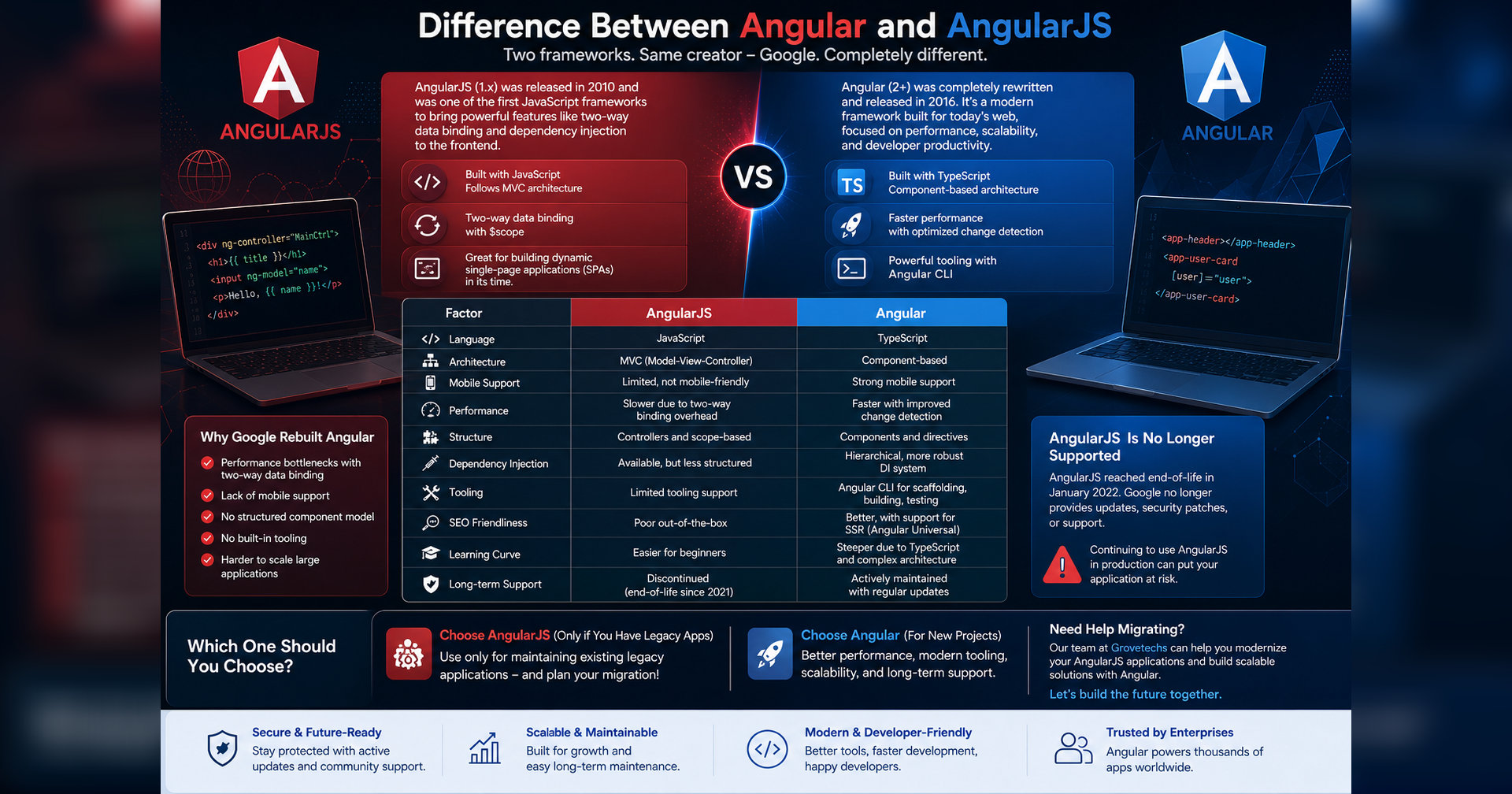
AngularJS (often called Angular 1.x) was released by Google in 2010. It was one of the first JavaScript frameworks to introduce the concept of two-way data binding and dependency injection to frontend development, making it hugely popular for building dynamic single-page applications (SPAs).
AngularJS is based on JavaScript and follows the MVC (Model-View-Controller) architecture.
What is Angular?
Angular (sometimes called Angular 2+, and currently on much higher versions) was a complete rewrite, released by Google in 2016. It wasn't an upgrade to AngularJS — it was a brand-new framework built from the ground up to address AngularJS's performance and scalability limitations.
Angular is based on TypeScript and follows a component-based architecture.
Key Differences Between Angular and AngularJS
| Factor | AngularJS | Angular |
|---|---|---|
| Language | JavaScript | TypeScript |
| Architecture | MVC (Model-View-Controller) | Component-based |
| Mobile Support | Limited, not mobile-friendly | Strong mobile support |
| Performance | Slower due to two-way binding overhead | Faster with improved change detection |
| Structure | Controllers and scope-based | Components and directives |
| Dependency Injection | Available, but less structured | Hierarchical, more robust DI system |
| Tooling | Limited tooling support | Angular CLI for scaffolding, building, testing |
| SEO Friendliness | Poor out-of-the-box | Better, with support for server-side rendering (Angular Universal) |
| Learning Curve | Easier for beginners | Steeper due to TypeScript and complex architecture |
| Long-term Support | Discontinued (end-of-life since 2021) | Actively maintained with regular updates |
Why Google Rebuilt Angular from Scratch
AngularJS worked well in its time, but as web applications grew more complex, several limitations became clear:
- Performance bottlenecks — Two-way data binding in AngularJS meant the framework had to constantly watch and update the DOM, which became slow for large applications.
- Lack of mobile support — AngularJS wasn't designed with mobile development in mind, which became a major drawback as mobile usage grew.
- No structured component model — AngularJS's controller-based structure made large applications harder to maintain and scale.
- No built-in tooling — Developers lacked standardized tools for testing, building, and scaffolding applications.
Google addressed all of these issues by building Angular as a completely new framework with TypeScript, a component-based architecture, and the Angular CLI for streamlined development.
Is AngularJS Still Used Today?
AngularJS officially reached end-of-life in January 2022, meaning Google no longer provides updates, security patches, or support for it. While some legacy applications still run on AngularJS, it's strongly recommended that businesses migrate to Angular (or another modern framework) for security, performance, and long-term maintainability reasons.
Should You Choose Angular or AngularJS in 2026?
This one's simple: Angular is the clear choice today. AngularJS is outdated, unsupported, and poses security risks for businesses that continue relying on it. Angular, on the other hand, is actively maintained, with frequent updates that improve performance, developer experience, and scalability.
If you're currently running an AngularJS application, here's what we typically recommend:
- Audit your existing application to understand its size, complexity, and dependencies
- Plan a phased migration rather than a full rewrite, especially for large applications
- Leverage tools like ngUpgrade to run AngularJS and Angular side-by-side during the transition
- Modernize your codebase by adopting TypeScript and component-based patterns gradually
Common Misconceptions
"Angular is just a newer version of AngularJS." This is one of the most common misunderstandings. Angular is a completely different framework, not an incremental update. Code written in AngularJS isn't directly compatible with Angular.
"Migrating from AngularJS to Angular is the same as updating Angular versions (e.g., Angular 14 to Angular 15)." Not even close. Updating between Angular versions is generally straightforward. Migrating from AngularJS to Angular often requires significant rearchitecting of the application.
Transform Your Business
How Grovetechs Can Help
Whether you're maintaining a legacy AngularJS application or planning to build something new in Angular, making the right architectural decisions early on can save significant time and cost down the road. Our team at Grovetechs specializes in both modern Angular development and legacy AngularJS-to-Angular migrations.
Contact Grovetchs Today and Start Your AI Journey!Our Development Services
- Legacy Application Modernization
- Web Application Development
- Custom Software Development
- SaaS Development
Our services cover everything from initial architecture planning to full-scale implementation, ensuring your application is built on a secure, scalable, and future-proof foundation.
Conclusion
While Angular and AngularJS share a name and a creator, they are fundamentally different frameworks built for different eras of web development. AngularJS served its purpose well but is no longer suitable for modern applications, while Angular continues to evolve into a robust, enterprise-ready framework.
If your business is still relying on AngularJS, now is the time to start planning your migration. And if you're starting a new project, Angular remains a strong, scalable choice for building modern web applications.
Need help deciding the right path forward? Our team at Grovetechs is here to guide you through it.
Frequently Asked Questions
Common questions about Difference Between Angular and AngularJS
Yes, AngularJS is commonly referred to as Angular 1.x. It's the original framework released in 2010, distinct from Angular (2+), which was a complete rewrite.
There's no direct, automatic upgrade path since the frameworks are fundamentally different. Migration typically involves rewriting components and adopting TypeScript, though tools like ngUpgrade can help with a phased transition.
Google ended long-term support for AngularJS in January 2022 to focus development resources on Angular, which offers better performance, scalability, and modern tooling.
Angular has a steeper learning curve due to TypeScript and its component-based architecture, but it offers better structure, tooling, and long-term maintainability for larger projects.
Yes. Since AngularJS no longer receives security updates or patches, continuing to use it in production increases the risk of unpatched vulnerabilities and compatibility issues.
It depends on the size and complexity of the application. Small applications might take a few weeks, while large enterprise systems can take several months, especially if a phased migration approach is used.
Prayag B
Frontend Architect · GroveTech Solutions
Prayag is a frontend architect at GroveTech Solutions with deep expertise in React, Next.js, and modern JavaScript frameworks. He helps engineering teams make informed technology decisions.
Our Services