
Contents
- 01What Is the Internet of Things?
- 02Common Internet of Things Devices You Already Use
- 03Everyday Internet of Things Examples
- 04Internet of Things Applications Across Industries
- Healthcare
- Manufacturing and Industrial IoT
- Agriculture
- Retail
- Smart Cities
- Logistics and Supply Chain
- Energy
- 12What Are the Applications of IoT?
- 13Building Your Own IoT Solution
- 14Conclusion
Take a look around you right now. The watch tracking your heartbeat, the speaker waiting for your voice command, the thermostat quietly adjusting the room temperature, the car in your driveway sending diagnostics to its manufacturer. Not long ago, these were ordinary, "dumb" objects. Today they talk, listen, and make decisions. This quiet revolution has a name, and understanding it starts with a simple question.
What Is the Internet of Things?
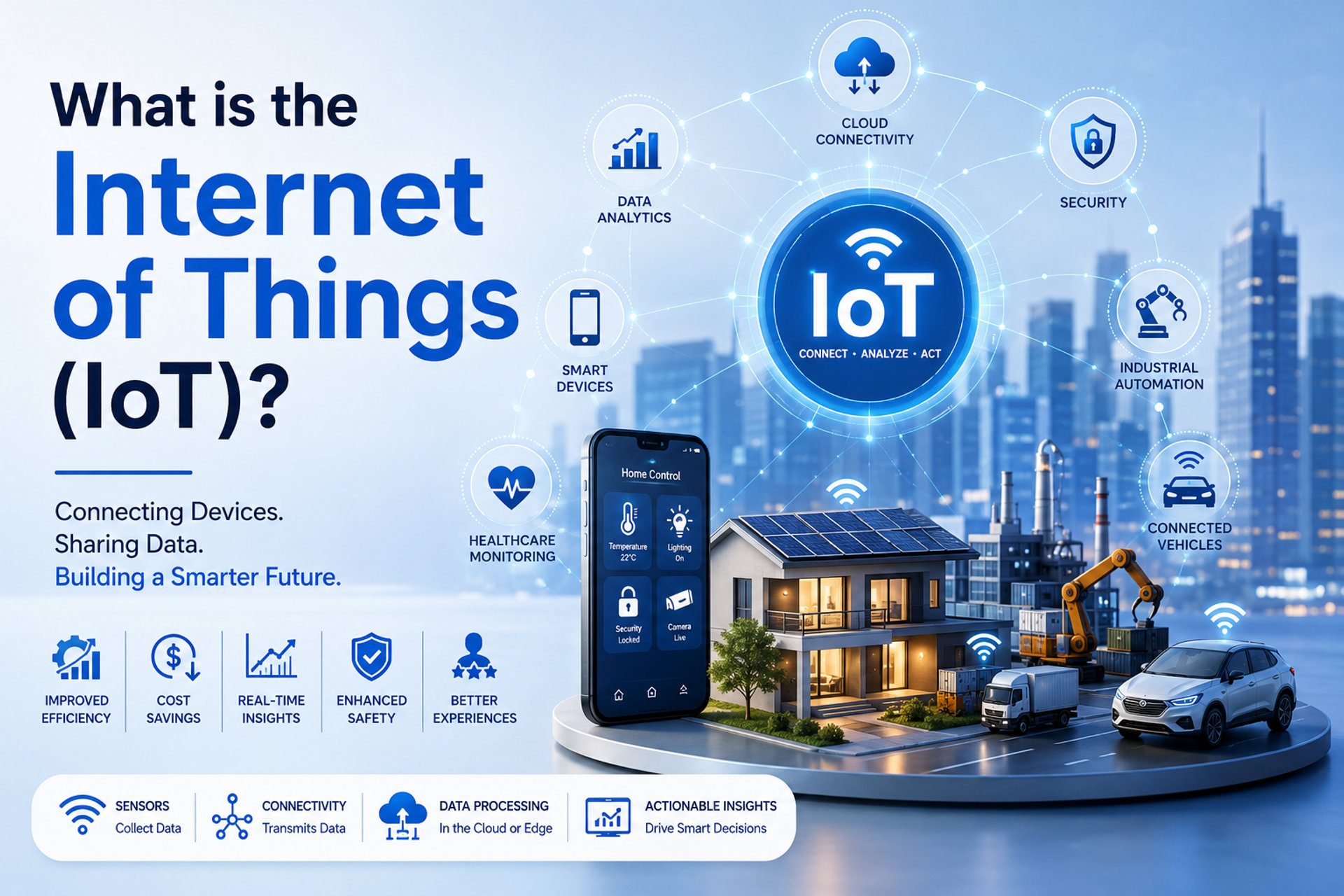
So, what is the internet of things? In plain terms, the Internet of Things (IoT) is a network of physical objects fitted with sensors, software, and internet connectivity that lets them collect data and exchange it with each other and with us, often with little or no human involvement. A "thing" can be almost anything: a fitness band, a factory machine, a doorbell, a shipping container, or an entire city's traffic system.
The scale is staggering. By 2026, the world is expected to have around 21.9 billion connected IoT devices, and that figure is projected to nearly double to over 40 billion by 2034. The average U.S. household alone now runs about 21 connected devices, up from just 15 a couple of years ago. IoT has moved well past being a buzzword. It is now the invisible infrastructure of modern life.
Common Internet of Things Devices You Already Use
Before diving into industry-scale systems, it helps to recognize the everyday Internet of Things devices most of us already own. These are the gateway products that brought IoT into ordinary homes.
Smart speakers like Amazon Echo and Google Nest respond to voice commands, play music, and control other gadgets. Smart thermostats such as the Nest Learning Thermostat study your habits and adjust heating automatically to save energy. Wearables like the Apple Watch and Fitbit monitor heart rate, sleep, and activity in real time. Smart doorbells and security cameras, such as Ring, let you see and speak to visitors from your phone. Even smart plugs, connected light bulbs, robot vacuums, and Wi-Fi-enabled refrigerators fall into this category. Each one is a small sensor and a small computer, connected to the cloud, quietly working in the background.
Everyday Internet of Things Examples
The most relatable Internet of Things examples live inside the modern smart home. Imagine your morning: your alarm rings, and as you wake, the lights slowly brighten, the coffee machine starts brewing, the blinds open, and your speaker reads out the day's weather and calendar. None of this required you to lift a finger. Devices shared data and acted on it automatically.
Connected cars are another powerful example. Modern vehicles stream real-time data about engine health, tire pressure, and location. They can alert you to maintenance needs before a breakdown happens, unlock via smartphone, and, in the case of Tesla and others, update their own software overnight. Fitness trackers offer a personal-health example: your smartwatch notices an irregular heartbeat and nudges you to see a doctor. These are not futuristic concepts. They are ordinary, present-day realities powered by IoT.
Internet of Things Applications Across Industries
While consumer gadgets grab attention, the biggest impact of Internet of Things applications is happening inside industries. This is where IoT quietly saves billions of dollars and, in some cases, lives.
Healthcare
Connected medical devices, often called the Internet of Medical Things, allow doctors to monitor patients remotely. Wearable ECG monitors, smart insulin pens, and connected blood-pressure cuffs send readings straight to hospitals, enabling early intervention. Hospitals use IoT to track equipment, monitor medication storage temperatures, and reduce human error. Remote patient monitoring alone is reshaping how chronic conditions are managed.
Manufacturing and Industrial IoT
The factory floor is one of the richest fields for IoT applications. Sensors on machines predict failures before they occur, a practice known as predictive maintenance, which slashes costly downtime. The manufacturing sector accounts for roughly 34 percent of all IoT device deployments worldwide, making it the single largest segment. Smart factories use connected robots, quality-control cameras, and real-time production dashboards to run leaner and faster.
Agriculture
Smart farming uses soil-moisture sensors, weather stations, and connected irrigation systems to tell farmers exactly when and how much to water, fertilize, or harvest. Drones survey crops, and GPS-guided tractors plant with precision. The result is higher yields with less water and waste, which matters enormously as the world's population grows.
Retail
Stores use IoT for smart shelves that detect when stock runs low, beacons that send personalized offers to shoppers' phones, and connected checkout systems. Amazon Go's cashier-less stores, where sensors track what you pick up and charge you automatically, are a striking example of retail IoT in action.
Smart Cities
Cities are becoming living IoT networks. Connected traffic lights in more than 145 U.S. cities have cut congestion by an average of 12 percent. Smart streetlights dim when no one is around to save power, sensors detect available parking spots, and connected bins signal when they need emptying. IoT-driven systems are even expected to improve emergency response times by 30 to 40 percent.
Logistics and Supply Chain
GPS trackers and condition sensors follow shipments across the globe, monitoring location, temperature, and humidity. A pharmaceutical company can now prove a vaccine stayed cold from factory to clinic. Remote asset monitoring is, in fact, the single most common IoT use case worldwide.
Energy
Smart meters give households and utilities real-time visibility into power consumption, while connected grids balance supply and demand and integrate renewable sources more efficiently.
What Are the Applications of IoT?
If you are still wondering what the applications of IoT are at a glance, here is the short answer. IoT applications span smart homes and wearables in daily life; predictive maintenance and automation in factories; remote patient monitoring in healthcare; precision farming in agriculture; inventory and personalization in retail; traffic, lighting, and waste management in smart cities; real-time tracking in logistics; and consumption monitoring in energy. The common thread is simple: sensors gather data, networks move it, and software turns it into smarter decisions.
Building Your Own IoT Solution
Understanding internet of things examples is one thing; building a reliable IoT product is another. It requires expertise across hardware sensors, secure connectivity, cloud infrastructure, data engineering, and increasingly, AI to make sense of the flood of data these devices generate. In fact, connected devices already produce nearly 80 zettabytes of data every year, and that raw information is worthless unless something intelligent turns it into action.
This is where a specialized technology partner earns its value. GroveTech Solutions, an award-winning software development and automation agency, helps businesses design and deploy connected solutions from the ground up. With deep expertise in custom software development, AI integration using leading models like GPT-4, Claude, and Gemini, cloud migration, and data engineering, GroveTech turns raw sensor data into intelligent, automated workflows. Whether you are prototyping a smart-home product or scaling an industrial monitoring platform, having a team that understands both the devices and the intelligence behind them makes all the difference.
Conclusion
The Internet of Things is no longer a glimpse of tomorrow; it is the fabric of today. From the smartwatch on your wrist to the sensors keeping a city running, IoT has woven itself into nearly every corner of modern life. As device counts climb toward 40 billion and artificial intelligence makes these systems smarter still, the internet of things applications we see now are only the beginning. For individuals, IoT means more convenience and safety. For businesses, it means efficiency, insight, and a genuine competitive edge. The question is no longer whether IoT will shape the future, but how creatively you will use it.
Frequently Asked Questions
Common questions about Top Software Companies in India
The internet of things is a network of everyday physical objects, such as watches, thermostats, cars, and machines, that are fitted with sensors and internet connectivity so they can collect and share data automatically. In short, IoT connects ordinary "things" to the internet, letting them communicate and act with little human input.
The best internet of things examples include smart home devices like Amazon Echo and Nest thermostats, wearables such as the Apple Watch and Fitbit, connected cars, smart doorbells like Ring, and industrial sensors used for predictive maintenance in factories. These examples span both consumer and enterprise use.
The main applications of IoT are smart homes, healthcare and remote patient monitoring, industrial manufacturing, precision agriculture, retail and inventory management, smart cities, logistics and supply-chain tracking, and energy management. Each uses sensors to collect data and software to automate smarter decisions.
Common internet of things devices include smart speakers, smart thermostats, fitness trackers and smartwatches, security cameras, smart doorbells, connected light bulbs, smart plugs, robot vacuums, and connected appliances. In industry, they include machine sensors, GPS trackers, and smart meters.
The internet of things is important in 2026 because there are already about 21.9 billion connected devices worldwide, driving efficiency, safety, and automation across daily life and business. IoT reduces costs, enables real-time monitoring, and forms the backbone of smart homes, smart factories, and smart cities.
Dhruvi Modiya
Software Engineer · GroveTech Solutions
Dhruvi is a software engineer at GroveTech Solutions who writes about SaaS, cloud technology, and modern software development to help businesses make informed technology decisions.