Contents
- 01What Is Java Web Page Development?
- 02Why Choose Java for Web Development?
- 03How Java Web Development Works
- 04The Best Java Web Development Frameworks
- Spring Boot
- Spring MVC
- Hibernate
- Jakarta EE
- Play Framework
- Vaadin
- Grails
- 12How to Build a Website With Java
- Step 1: Set Up Your Environment
- Step 2: Create Your Project
- Step 3: Design Your Structure
- Step 4: Connect a Database
- Step 5: Build Your Features
- Step 6: Test Thoroughly
- Step 7: Deploy
- 20Our Development Services
- 21Conclusion
For more than two decades, Java has quietly powered some of the largest and most demanding websites on the planet. From banking portals and airline booking systems to the back-ends of companies like Netflix, LinkedIn, and Amazon, Java has proven itself as a reliable, secure, and scalable choice for the web.
If you are wondering whether Java is still relevant for building modern websites, the answer is a firm yes. This guide walks you through everything you need to know about Java web page development - from the fundamentals to the frameworks that make it fast.
What Is Java Web Page Development?
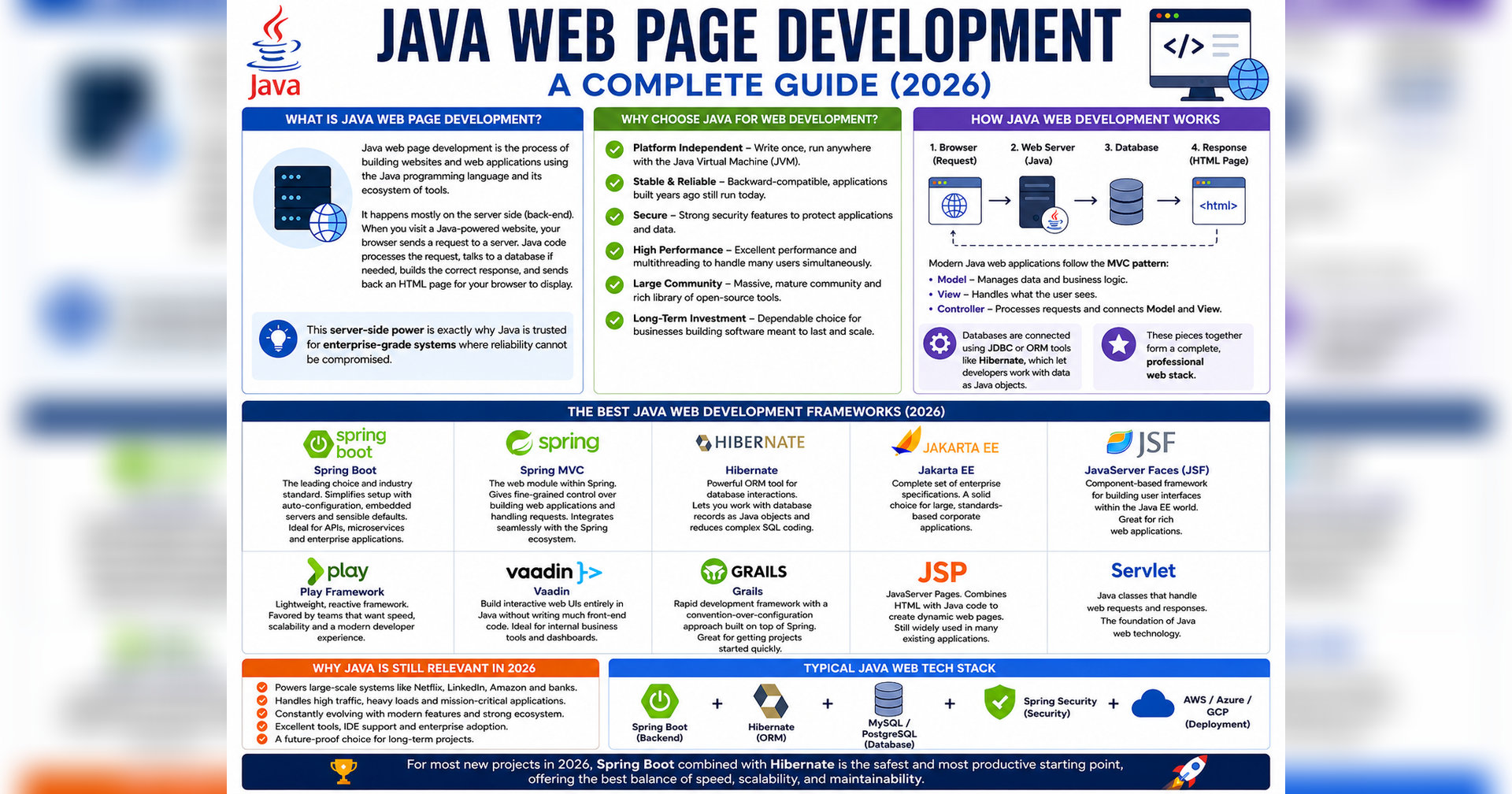
Java web page development is the process of building websites and web applications using the Java programming language and its ecosystem of tools. Unlike a simple static page written only in HTML, Java lets you create dynamic, data-driven web applications that can handle logins, process transactions, manage databases, and serve millions of users at once.
At its core, Java programming for web development happens mostly on the server side, also called the back-end. When you visit a Java-powered website, your browser sends a request to a server. Java code processes that request, talks to a database if needed, builds the correct response, and sends back an HTML page for your browser to display. This server-side power is exactly why Java is trusted for enterprise-grade systems where reliability cannot be compromised.
Why Choose Java for Web Development?
Java has stayed at the top of the web development world for good reasons:
- Platform-independent - code written once can run anywhere thanks to the Java Virtual Machine
- Stable and backward-compatible - applications built years ago still run today
- Strong security features - trusted for banking, healthcare, and government systems
- Excellent multithreading - a single application can handle huge numbers of simultaneous users
- Massive ecosystem - a rich library of open-source tools and a large global community
For businesses building software meant to last and scale, these qualities make Java a dependable long-term investment rather than a passing trend.
How Java Web Development Works
To understand Java web page development, it helps to know the building blocks that make it possible.
In the early days, developers used Servlets - Java classes that handle web requests - and JSP (JavaServer Pages), which mix HTML with Java code to generate dynamic pages. These technologies still exist and form the foundation of the Java web stack.
Modern development, however, rarely uses raw Servlets and JSP alone. Instead, developers rely on frameworks that handle the repetitive plumbing, letting them focus on features.
Most Java web applications follow the MVC pattern — Model-View-Controller:
- Model — manages data and business logic
- View — handles what the user sees
- Controller — connects the two by processing requests
This clean separation keeps large applications organized and maintainable.
Java web applications also connect to databases using tools like JDBC or, more commonly, an ORM tool such as Hibernate, which lets developers work with database records as if they were ordinary Java objects.
The Best Java Web Development Frameworks
Choosing the right framework is one of the most important decisions in any project. Here are the top options dominating the field in 2026:
Spring Boot
Widely regarded as the industry standard, Spring Boot dramatically simplifies setup with sensible defaults, embedded servers, and auto-configuration. It is ideal for everything from REST APIs and microservices to full enterprise applications.
Spring MVC
The web module within Spring gives developers fine-grained control over building web applications and handling requests — pairs naturally with the broader Spring toolkit.
Hibernate
An essential ORM tool that handles database interactions, saving developers from writing endless SQL and letting them manage data through Java objects.
Jakarta EE
Formerly Java EE, provides a complete set of enterprise specifications and remains a solid choice for large, standards-based corporate systems.
Play Framework
A lightweight, reactive approach favored by teams that want speed and a modern developer experience.
Vaadin
Lets developers build interactive web UIs entirely in Java, without writing much front-end code — great for internal business tools.
Grails
Brings a rapid, convention-over-configuration style built on top of Spring, ideal for getting projects off the ground quickly.
For most new projects in 2026, Spring Boot combined with Hibernate is the safest and most productive starting point.
How to Build a Website With Java
Here is a clear roadmap to build a website with Java — from setup to launch:
Step 1: Set Up Your Environment
Install the Java Development Kit (JDK), a build tool like Maven or Gradle to manage your project and dependencies, and an IDE such as IntelliJ IDEA or Eclipse.
Step 2: Create Your Project
Using Spring Initializr, generate a ready-to-run Spring Boot project in seconds, choosing exactly the dependencies you need - such as Spring Web and a database connector.
Step 3: Design Your Structure
Build your Controllers to handle incoming web requests, your Models to represent your data, and your Views - often using a template engine like Thymeleaf - to render the HTML pages users see.
Step 4: Connect a Database
Configure your application to talk to a database such as MySQL or PostgreSQL, and use Hibernate to map your Java objects to database tables so you can save and retrieve data cleanly.
Step 5: Build Your Features
Write the logic for your pages, forms, user accounts, and any business rules your site needs. Spring Boot's embedded server lets you run and test everything locally with a single command.
Step 6: Test Thoroughly
Check functionality, performance, and security across browsers and devices — fixing bugs before they reach real users.
Step 7: Deploy
Package your application and host it on a cloud platform like AWS, Azure, or Google Cloud, then monitor and maintain it as it grows.
Transform Your Business
Building Your Java Web Application With the Right Partner
Java is powerful, but building a secure, scalable, enterprise-ready web application takes real expertise across frameworks, databases, cloud deployment, and AI-driven features. Getting the architecture right from the start saves enormous time and cost later.
Contact Grovetchs Today and Start Your AI Journey!Our Development Services
- Custom Software Development
- Web Application Development
- Cloud Migration Services
- AI Consulting & Integration
- Legacy Application Modernization
Whether you are launching a new Java-based platform or modernizing a legacy enterprise system, Grovetechs ensures your project is built on solid, future-ready foundations.
Conclusion
Java has earned its place as one of the most trusted languages for web development, and it shows no signs of slowing down. Its stability, security, and scalability make it the backbone of countless enterprise systems, while modern frameworks like Spring Boot make Java web page development faster and more enjoyable than ever.
Whether you are a developer learning Java programming for web development or a business ready to build a website with Java, the ecosystem offers everything you need to succeed.
Frequently Asked Questions
Common questions about Java Web Page Development
Java web page development is the process of building dynamic websites and web applications using the Java programming language. It works mainly on the server side, where Java processes requests, connects to databases, and generates web pages.
Spring Boot is widely considered the best Java web development framework in 2026. It simplifies setup with auto-configuration and embedded servers, and is ideal for building REST APIs, microservices, and full enterprise applications.
Yes. Using tools like the JDK, a build tool such as Maven, and a framework like Spring Boot, developers can build, test, and deploy complete websites — from small apps to platforms serving millions of users.
Yes, Java remains excellent for web development in 2026. It powers major platforms like Netflix, LinkedIn, and countless banking systems thanks to its stability, security, scalability, and mature ecosystem.
For Java programming for web development, you mainly work on the back-end. However, a working knowledge of HTML, CSS, and JavaScript is very helpful. Template engines like Thymeleaf connect your Java back-end to the pages users see.
Dhruvi Modiya
Software Engineer · GroveTech Solutions
Dhruvi is a software engineer at GroveTech Solutions who writes about SaaS, cloud technology, and modern software development to help businesses make informed technology decisions.
Our Services