Contents
For nearly a decade, React JS has been the backbone of modern web development.
But with frameworks like Svelte, SolidJS, Qwik, and meta-frameworks like Next.js and Remix grabbing headlines, many businesses and developers are asking the same question: is React still relevant in 2026, or is it time to move on?
At Grovetechs, we work with startups and enterprises every day, helping them choose the right technology stack for their products. In this post, we'll break down how React stacks up against the newer wave of JavaScript frameworks — and why it still remains one of the smartest choices for most projects.
Why React Became the Industry Standard
React was introduced by Facebook (now Meta) in 2013, and it quickly became the go-to library for building user interfaces. Its component-based architecture, virtual DOM, and massive ecosystem made it the default choice for everything from small landing pages to complex enterprise dashboards.
Some of the reasons React earned its dominance include:
- A mature ecosystem — thousands of libraries, tools, and integrations built around it
- A huge talent pool — millions of developers worldwide already know React
- Strong corporate backing — continued investment from Meta and the open-source community
- Flexibility — it can be used for web, mobile (React Native), and even desktop apps
The Rise of New Frameworks
Newer frameworks have emerged specifically to solve some of React's pain points — bundle size, runtime performance, and boilerplate code. Here's a quick look at a few contenders:
Svelte
Svelte compiles components into highly optimized vanilla JavaScript at build time, which means there's no virtual DOM overhead at runtime. This often results in faster load times and smaller bundle sizes.
SolidJS
SolidJS offers React-like syntax but with fine-grained reactivity instead of a virtual DOM, giving it impressive performance benchmarks while still feeling familiar to React developers.
Qwik
Qwik focuses on instant-loading websites by using a technique called resumability, which delays JavaScript execution until it's actually needed by the user.
Vue.js
Vue has been a long-standing competitor to React, offering a simpler learning curve and a more opinionated structure out of the box.
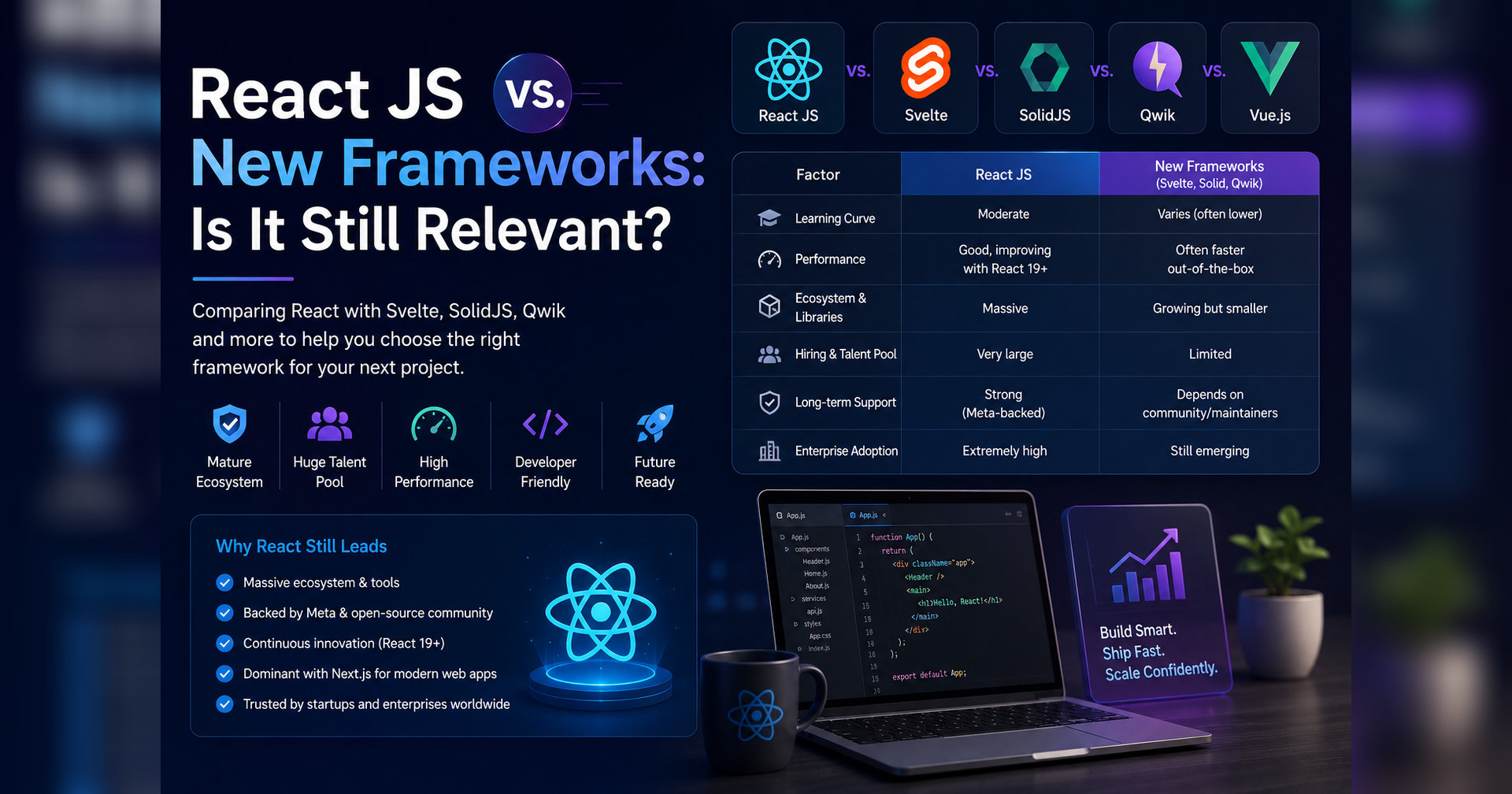
React JS vs New Frameworks: A Practical Comparison
| Factor | React JS | New Frameworks (Svelte, Solid, Qwik) |
|---|---|---|
| Learning Curve | Moderate | Varies (often lower) |
| Performance | Good, improving with React 19+ | Often faster out-of-the-box |
| Ecosystem & Libraries | Massive | Growing but smaller |
| Hiring & Talent Pool | Very large | Limited |
| Long-term Support | Strong (Meta-backed) | Depends on community/maintainers |
| Enterprise Adoption | Extremely high | Still emerging |
Is ReactJS Still Relevant?
The short answer: yes, absolutely.
While newer frameworks bring genuine performance advantages in specific use cases, React's relevance isn't about being the fastest framework on a benchmark chart — it's about being the most reliable, well-supported, and scalable option for real-world products.
Here's why React continues to hold its ground:
- Ecosystem maturity — Need a UI library, state management tool, testing framework, or animation library? React almost certainly has a battle-tested option.
- React Server Components & React 19+ — React has continued to evolve, closing the performance gap with newer frameworks through server components, concurrent rendering, and improved compiler optimizations.
- Next.js dominance — As a meta-framework built on React, Next.js has become the standard for SEO-friendly, performant, full-stack web applications.
- Hiring is easier — Finding experienced React developers is significantly easier than finding specialists in newer, niche frameworks.
- Enterprise trust — Large companies prioritize stability and long-term support over chasing the newest trend, and React delivers both.
When Should You Consider a Newer Framework?
That said, React isn't always the right tool for every job. You might consider a newer framework if:
- You're building a small, performance-critical microsite where bundle size is the top priority
- Your team values simplicity and a smaller learning curve over ecosystem size
- You're experimenting with cutting-edge rendering techniques for a specific use case
For most production-grade web applications, however, React (especially paired with Next.js) remains the safer, more scalable, and more future-proof choice.
Transform Your Business
How Grovetechs Can Help
Choosing the right framework can make or break your project's scalability, performance, and long-term maintainability. Our team at Grovetechs specializes in building high-performance web applications using React, Next.js, and other modern frameworks tailored to your specific business needs.
Contact Grovetchs Today and Start Your AI Journey!Our Web Development Services
Whether you're starting a new project or considering a migration, our development services can help you make the right technical decisions from day one.
Conclusion
React JS is far from outdated. While the JavaScript ecosystem will always produce new frameworks promising better performance or simpler syntax, React's combination of ecosystem maturity, continuous innovation, and massive community support keeps it firmly relevant in 2026 and beyond.
The real question isn't "Is React still relevant?" It's "What does your specific project actually need?" And for the vast majority of businesses, React still provides the best balance of performance, scalability, and developer availability.
If you're unsure which framework is right for your next project, our team at Grovetechs is here to guide you through the decision.
Frequently Asked Questions
Common questions about React JS vs. New Frameworks
No. React continues to be one of the most widely used and actively maintained JavaScript libraries, with continuous updates like React 19 and strong backing from Meta and the developer community.
In certain benchmarks, yes — these frameworks can offer faster load times and smaller bundle sizes. However, real-world performance also depends on architecture, optimization, and use case, where React with Next.js performs very well.
Most startups benefit from React due to its larger talent pool, ecosystem, and long-term support. Newer frameworks may suit specific, performance-critical, smaller-scale projects.
Usually not, unless you're facing specific performance bottlenecks that React can't solve. Migrations are costly and time-consuming, and React's continuous improvements often address these issues without a full rewrite.
It depends on your project's scale, performance requirements, team expertise, and long-term goals. Consulting with an experienced development team like Grovetechs can help you choose the right framework with confidence.
Prayag B
Frontend Architect · GroveTech Solutions
Prayag is a frontend architect at GroveTech Solutions with deep expertise in React, Next.js, and modern JavaScript frameworks. He helps engineering teams make informed technology decisions.
Our Services