
Contents
- 01What Is a Multi-Agent System?
- 02Five Signs One Agent Isn't Enough
- 1. Tool overload
- 2. Context window pressure
- 3. Genuinely different expertise
- 4. Independent parallel work
- 5. Different trust levels
- 08The Core Multi-Agent Patterns
- Orchestrator-Worker (Supervisor)
- Sequential Pipeline
- Parallel Fan-Out / Fan-In
- Hierarchical Teams
- Critic / Reviewer Loop
- 14How Agents Actually Communicate
- 15Multi-Agent Systems in Practice
- 16When You Should Not Build a Multi-Agent System
- 17Migrating From One Agent to Many
- 18Why Build Multi-Agent Systems With GroveTech Solutions
There's a predictable moment in every AI agent project. The agent works. The team adds a capability. It still works. They add three more. Now it calls the wrong tool at step four, forgets the constraint it was given at step one, and nobody can explain why.
That's not a prompt problem. It's an architecture problem - and it's the point where most teams start looking at multi-agent systems.
But "add more agents" is also the most over-prescribed fix in AI engineering right now. Plenty of systems marketed as multi-agent would run faster, cheaper and more reliably as one well-scoped agent. This guide covers what multi-agent systems actually are, the signals that you genuinely need one, the patterns that work in production, and the cases where you should absolutely not build one.
If you're earlier in the journey, start with what agentic AI actually is and how a single agent works - multi-agent architecture is a second-system decision, not a first one.
What Is a Multi-Agent System?
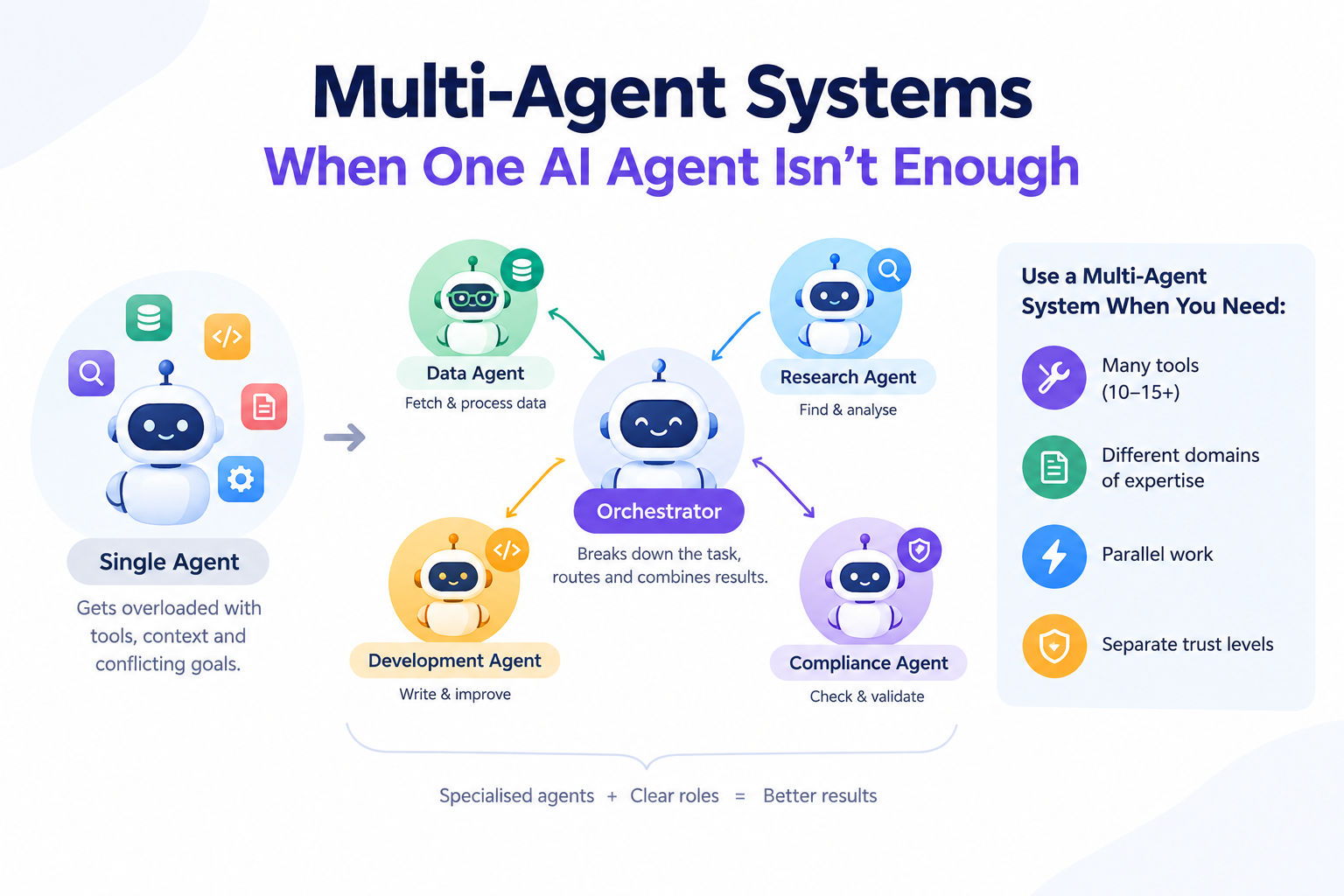
A multi-agent system (MAS) is a set of autonomous AI agents that collaborate to achieve an objective no single agent handles well alone. Each agent has:
- A narrow role - "extract data from invoices," not "handle finance."
- Its own toolset - only the APIs that role requires.
- Its own instructions and context - scoped, not global.
- A communication channel - a way to receive work and hand off results.
The value isn't more intelligence. It's separation of concerns. The same reason you don't write an application as one 8,000-line function applies here: bounded responsibility makes behaviour predictable and failures debuggable. Teams evaluating an AI development partner for this kind of build should ask specifically how that team scopes agent boundaries, not just which model they use.
Five Signs One Agent Isn't Enough
1. Tool overload
Past roughly 10-15 tools, model accuracy in tool selection degrades noticeably. The agent starts picking plausible-but-wrong functions. Splitting tools across specialised agents restores precision.
2. Context window pressure
When your system prompt carries rules for six different domains, instructions compete. The agent follows the refund policy while ignoring the fraud check. Smaller, focused contexts produce sharper behaviour.
3. Genuinely different expertise
A research task, a compliance review and a customer-facing summary need different tones, different reasoning depth and different risk tolerance. One prompt can't optimise for all three.
4. Independent parallel work
If three sub-tasks don't depend on each other - enrich the company, check the credit history, scan the news - running them sequentially wastes wall-clock time. Parallel agents cut latency substantially, which matters most in the AI agent use cases where speed to first contact is the metric that gets measured.
5. Different trust levels
Reading data and writing money should not live in the same agent. Separation lets you apply strict approval gates and least-privilege credentials only where they're needed.
The Core Multi-Agent Patterns
Orchestrator-Worker (Supervisor)
A lead agent receives the objective, decomposes it, routes sub-tasks to specialist workers, and assembles the final result. The most common production pattern and the easiest to reason about. Control stays centralised, which makes logging and error handling straightforward.
Use for: customer request handling, research assembly, document processing pipelines.
Sequential Pipeline
Agents run in a fixed order, each transforming the output of the last: extract, validate, enrich, post. Deterministic, cheap, easy to test. Closest in spirit to conventional workflow automation, which we cover in our AI workflow automation guide.
Use for: document intake, ETL-style processes, content production.
Parallel Fan-Out / Fan-In
The orchestrator dispatches independent sub-tasks simultaneously, then a synthesiser agent merges the results. Big latency wins, higher token cost.
Use for: multi-source research, lead enrichment, competitive analysis.
Hierarchical Teams
Orchestrators of orchestrators. A top-level agent delegates to team leads, who delegate to specialists. Powerful for large processes, but the coordination overhead is real - only justified at genuine enterprise scale, and usually alongside the kind of data engineering foundation that keeps every layer working from consistent data.
Use for: end-to-end operations spanning multiple departments.
Critic / Reviewer Loop
One agent produces, a second critiques against explicit criteria, the first revises. Meaningfully improves output quality on writing, code and analysis - at roughly double the cost per run.
Use for: anything where quality matters more than speed.
How Agents Actually Communicate
Three mechanisms dominate, and mixing them carelessly is where systems get fragile.
Handoffs. Agent A transfers control and context to Agent B. Clean, traceable, and the safest default. The critical detail is what gets passed: full transcript, or a structured summary? Full transcripts blow up cost; summaries lose nuance. Most production systems pass a typed object with the essentials plus a pointer to the full log.
Shared state. All agents read and write a common state object - a task board, a scratchpad, a database row. Efficient, but you inherit every concurrency problem from distributed systems: race conditions, stale reads, conflicting writes. Version your state and make writes atomic. This is standard distributed-systems discipline applied to an AI system, not a new problem invented by agents.
Message passing. Agents publish to queues and subscribe to topics, event-driven style. Scales well and decouples components, but debugging becomes genuinely hard without solid tracing. This is where the cloud infrastructure and DevOps practices underneath your agents start mattering more than the agents themselves.
Emerging standards - MCP for tool interfaces, agent-to-agent protocols for inter-agent communication - are converging on structured, typed exchanges rather than free-text conversation. Design for structured handoffs now and you'll be aligned with where the ecosystem is heading.
Multi-Agent Systems in Practice
Financial operations. An intake agent classifies incoming documents, an extraction agent pulls line items, a matching agent reconciles against purchase orders, an exception agent drafts vendor queries, and a posting agent writes to the ERP behind an approval gate. Five narrow agents, five clean audit trails.
Sales pipeline. A research agent profiles the account, a news agent scans for triggers, a scoring agent ranks fit against ICP, and a drafting agent produces outreach. Parallel fan-out cuts a 20-minute manual task to under a minute.
Software delivery. A triage agent classifies incidents, a diagnosis agent inspects logs and traces, a remediation agent drafts the fix, a reviewer agent checks it against standards before a human approves the merge.
Customer operations. A router agent classifies intent, domain agents handle billing, shipping and technical issues separately, and an escalation agent packages context for the human who takes over - a very different shape of automation from a single conversational agent.
You can see how architectures like these translate into delivered systems across the industries we serve.
When You Should Not Build a Multi-Agent System
Honest counterweight, because this is where budgets disappear:
- Your single agent hasn't been optimised yet. Better tool descriptions, tighter prompts and structured outputs solve most "we need more agents" problems.
- The workflow is linear and deterministic. Use a pipeline or plain code. Not everything needs an LLM in the loop.
- You lack observability. Debugging multi-agent failures without distributed tracing is close to impossible.
- Latency is critical. Every handoff adds a round trip. Multi-agent systems are frequently slower.
- Budget is tight. Costs multiply with agent count, and critic loops double them again.
The rule of thumb: exhaust single-agent optimisation first. Add agents when you hit a structural ceiling, not when the output disappoints.
Migrating From One Agent to Many
- Instrument first. You need traces before you can split anything sensibly.
- Find the seam. Look for clusters of tools that are used together and rarely alongside others - that's a natural agent boundary.
- Extract one specialist. Pull out the clearest role, keep everything else intact, measure the difference.
- Define the contract. Typed inputs and outputs between agents, not free text.
- Re-run your evaluation suite. Success rate, cost per run, latency, escalation rate - compare against the single-agent baseline honestly.
- Repeat only if the numbers justify it.
The engineering discipline here is ordinary distributed-systems work, which is why these builds usually sit alongside custom software development rather than being treated as an AI experiment. Teams still validating the underlying idea are often better served starting with an MVP - prove one agent earns its keep before you architect a team of them.
Why Build Multi-Agent Systems With GroveTech Solutions
Multi-agent systems are a scaling answer, not a starting point. They solve real structural limits - tool overload, context conflict, parallelism, trust separation - and they introduce real costs in latency, spend and debugging complexity. GroveTech Solutions designs and ships these systems end to end: instrumenting the single-agent baseline first, finding the real seam in the traces, and only then splitting into an orchestrator-worker, pipeline, or fan-out architecture that earns its added cost.
Considering a multi-agent architecture? Explore our AI integration and consulting services, see delivered work in our portfolio, read more implementation guides on the blog, or contact our team for a free consultation.
Frequently Asked Questions
Common questions about Multi-Agent Systems Explained
It's an architecture where multiple specialised AI agents, each with a defined role, its own tools and its own context, collaborate on a task through orchestration or handoffs. The goal is separation of concerns, not extra intelligence.
When a single agent exceeds roughly 10-15 tools, when instructions for different domains conflict in one prompt, when sub-tasks can run in parallel, or when read-only and write-access operations need different trust levels.
A supervisor agent receives the objective, breaks it into sub-tasks, routes each to a specialist worker agent, then assembles the results. It's the most common production multi-agent pattern because control and logging stay centralised.
Not usually. Parallel fan-out patterns reduce wall-clock time on independent sub-tasks, but every handoff adds a round trip. Sequential and hierarchical multi-agent systems are typically slower than a single well-scoped agent.
Yes. Each agent carries its own context and model calls, and critic loops roughly double token usage per run. Track cost per completed task, not cost per call, and compare it against the single-agent baseline.
Through handoffs (transferring control plus context), shared state (a common object all agents read and write), or message passing over queues and events. Structured, typed exchanges are more reliable than free-text conversation.
LangGraph for explicit state machines and control flow, CrewAI for role-based delegation, AutoGen for conversational multi-agent patterns, and n8n for visual orchestration. Choose based on who maintains it after launch.
With distributed tracing across every agent, tool call and handoff. Log the inputs and outputs at each boundary, tag runs with a correlation ID, and replay failed runs against your evaluation suite. Without tracing, multi-agent debugging is guesswork.
Workflow automation follows predetermined branches. A multi-agent system lets each agent reason about its sub-task and decide its own steps, with the orchestrator adapting the plan based on intermediate results.
As few as the problem requires. Most effective production systems run three to six specialists. Beyond that, coordination overhead and costs usually grow faster than the gains in accuracy.
Sharad Patel
Software Engineer · GroveTech Solutions
A member of the GroveTech Solutions engineering team, passionate about building great software and sharing knowledge with the developer community.
Our Services


