Contents
From Instagram and Spotify to Dropbox and Netflix, some of the most-used platforms on the internet share a common ingredient: Python. Once known mainly as a beginner-friendly scripting language, Python has grown into one of the most powerful and popular choices for building fast, scalable web applications. If you are a business planning your next platform or a developer choosing a stack, understanding Python web development will help you make smarter decisions. This guide covers everything from the basics to the frameworks and features that make Python a top-tier web technology in 2026. If you are completely new to the field, start with our explainer on what web development is.
What Is Python Web Development?
Python web development is the process of building websites, web applications, and back-end systems using the Python programming language and its rich ecosystem of frameworks and libraries. When people talk about python for web development, they usually mean server-side, or back-end, work: the logic that runs behind the scenes, connects to databases, handles user requests, and delivers the right content to the browser.
The relationship between Python and web programming is a natural fit. Python's clean, readable syntax means developers write less code to achieve more, which speeds up projects and reduces bugs. A task that might take dozens of lines in another language often takes just a few in Python. That efficiency, combined with a vast collection of ready-made tools, is exactly why so many startups and enterprises reach for Python when they need to move quickly without sacrificing quality.
Why Choose Python for Web Development?
Python stands out for several practical reasons. First, it enables rapid development. Its simplicity and huge library ecosystem let teams build and launch products faster, which is critical for startups racing to validate ideas through an MVP and for enterprises shipping features on tight deadlines.
Second, Python scales beautifully. The same language that powers a weekend side project also runs Instagram, which serves hundreds of millions of users. With the right architecture, Python applications handle heavy traffic and growing data with ease.
Third, Python is a leader in artificial intelligence, machine learning, and data science. If your web application needs recommendation engines, predictive analytics, chatbots, or AI-driven features, Python lets you build the website and the intelligence in the same language, with no awkward stitching together of separate systems. Our AI consulting and integration services build on exactly this strength.
Finally, Python has one of the largest, most active developer communities in the world. That means abundant documentation, tutorials, and support, plus a deep talent pool for hiring. For any business thinking long-term, that ecosystem is a genuine asset.
Top Python Web Development Frameworks
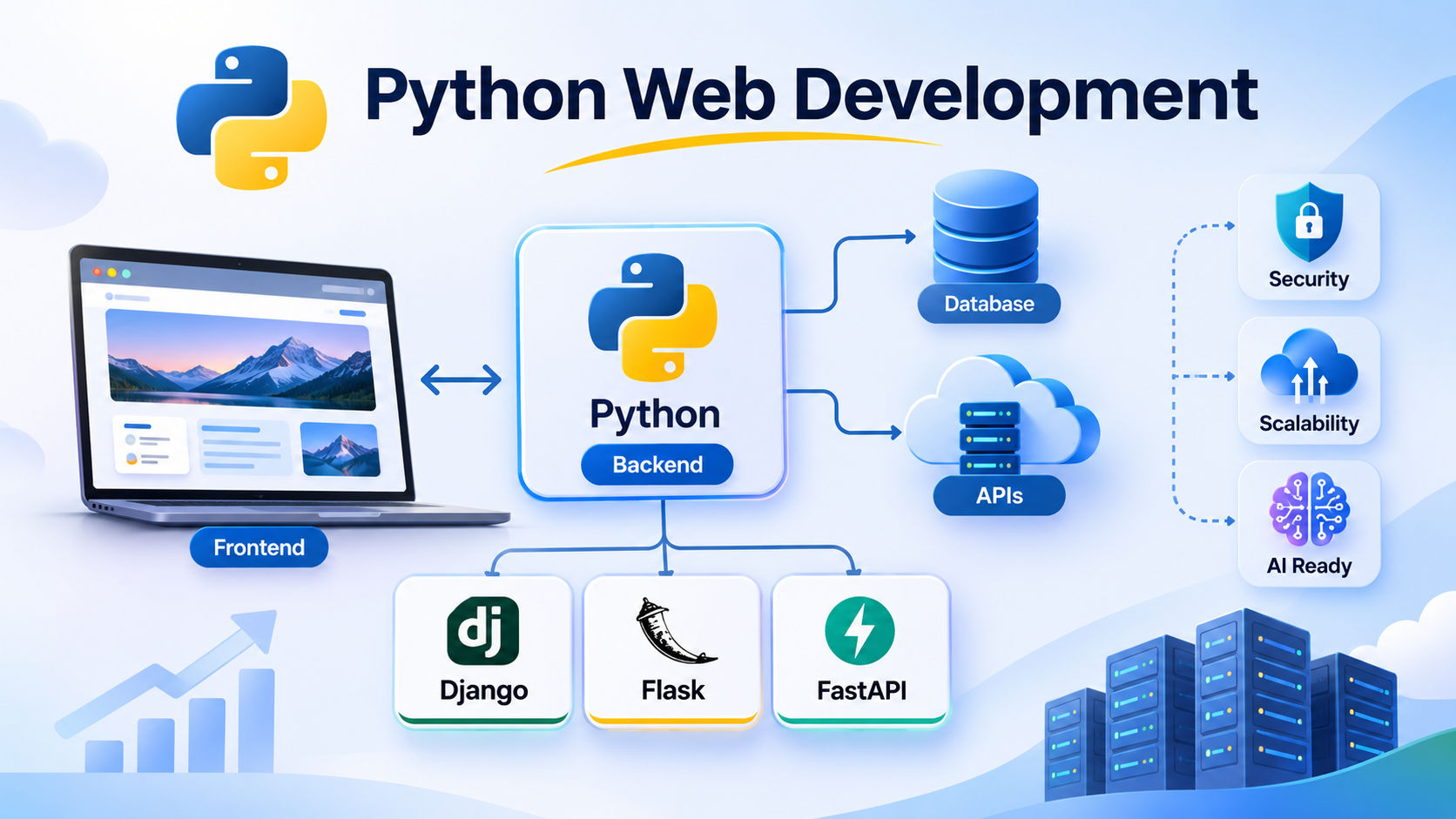
Frameworks do the heavy lifting so developers do not have to reinvent common features like routing, security, and database access. Choosing among python web development frameworks depends on your project's size and goals, but a few clearly lead the field.
Django is the most popular full-stack framework and a favorite for building robust, feature-rich applications quickly. It follows a "batteries included" philosophy, shipping with an admin panel, authentication, an ORM for databases, and strong security out of the box. Django is ideal for content-heavy sites, e-commerce, and large enterprise applications where you want structure and speed.
Flask is a lightweight, flexible micro-framework. It gives developers freedom to build exactly what they need without extra baggage, making it perfect for smaller apps, APIs, and projects where you want fine control over every component.
FastAPI has surged in popularity and is now a go-to for building high-performance APIs. As its name suggests, it is extremely fast, supports asynchronous programming, and automatically generates interactive API documentation. For modern, API-driven and microservice architectures, FastAPI is often the best choice.
Pyramid sits between Django and Flask, offering flexibility that scales from simple apps to complex systems. Tornado and Bottle round out the options, with Tornado excelling at handling many simultaneous connections and Bottle being a minimalist single-file framework for tiny projects.
For most business applications in 2026, Django and FastAPI cover the vast majority of needs, with Flask a strong pick for lightweight builds. If you are weighing Python against a JavaScript runtime for your back end, our comparison of Node.js and Next.js helps frame the trade-offs.
Key Python Web Application Features
Modern Python web application features go well beyond simple pages. A professionally built Python application typically includes secure user authentication and authorization, so the right people access the right data. It offers seamless database integration through ORMs like Django's or SQLAlchemy, letting developers manage data as clean Python objects.
Other common features include RESTful APIs that let your web app communicate with mobile apps and third-party services, real-time functionality such as live chat or notifications, and strong security protections against common threats like SQL injection and cross-site scripting. Increasingly, Python web applications also ship with AI and machine-learning features, from personalized recommendations to intelligent search and automation. Because Python handles data so gracefully, adding analytics dashboards and reporting is straightforward too. Together, these features make Python applications powerful, flexible, and genuinely enterprise-ready.
How Python Web Applications Are Built
Building a Python web application follows a clear, logical path. It begins with planning, where the team defines the goals, features, and target audience. Next comes choosing the stack, typically a framework like Django or FastAPI, a database such as PostgreSQL, and any needed libraries.
Developers then set up the environment and structure the project, usually around the Model-View-Controller pattern or Django's similar Model-View-Template approach. From there, they build the back-end logic, connect the database, create the pages or API endpoints, and integrate any front-end technology, since Python back-ends often pair with HTML, CSS, and JavaScript or a modern framework like React on the front. Our web development services team regularly pairs Python back ends with modern front-end stacks.
After development comes rigorous testing for functionality, performance, and security, followed by deployment to a cloud platform like AWS, Google Cloud, or Azure. Automating releases with CI/CD tools and a managed DevOps pipeline keeps deployments repeatable. Finally, ongoing maintenance keeps the application secure, fast, and up to date. Following this disciplined process is what separates a fragile prototype from a reliable, scalable product.
Working With a Custom Python Web Development Company
While Python makes development faster, building a secure, scalable, production-grade web application still demands real expertise in architecture, databases, cloud infrastructure, and modern best practices. This is where partnering with a custom python web development company pays off, saving you the costly trial and error of learning as you go.
GroveTech Solutions is an award-winning software and web development agency that helps businesses design and build fast, scalable web applications tailored to their exact needs. Our team brings deep experience in custom software development, full-stack engineering, SaaS platforms, cloud migration, and AI integration using leading models like GPT-4, Claude, and Gemini, a natural strength given Python's dominance in AI. Whether you are launching a new Python-based product, building a data-driven platform, or modernizing a legacy system, working with seasoned developers like ours ensures your application is built on solid, future-ready foundations. Browse our portfolio and the industries we serve to see the kind of products we deliver.
Conclusion
Python has firmly established itself as one of the best languages for building fast, scalable web applications. Its clean syntax accelerates development, its frameworks like Django, Flask, and FastAPI cover every kind of project, and its unmatched strength in AI and data science future-proofs whatever you build. Whether you are a developer exploring python for web development or a business ready to launch a serious platform, Python gives you the speed, flexibility, and power to compete. Start with the right framework, follow a disciplined process, and, when the stakes are high, lean on experienced partners to bring your vision to life. The combination of Python and web programming remains one of the smartest choices you can make in 2026.
Ready to build? Book a free consultation with our engineering team.
Frequently Asked Questions
Common questions about Python Web Development
Python web development is the process of building websites and web applications using the Python programming language and frameworks like Django, Flask, and FastAPI. It focuses mainly on server-side, or back-end, work such as handling requests, managing databases, and running application logic. Python is popular for web development because it is fast to write, scalable, and reliable.
The best python web development frameworks in 2026 are Django, Flask, and FastAPI. Django is a full-stack framework ideal for large, feature-rich applications; Flask is a lightweight micro-framework great for small apps and APIs; and FastAPI is a high-performance framework built for fast, modern, API-driven projects. Pyramid, Tornado, and Bottle are also popular options.
Yes, Python is excellent for web development. It powers major platforms like Instagram, Spotify, and Dropbox thanks to its simplicity, scalability, and strong ecosystem. Python enables rapid development, handles heavy traffic well, and leads in AI and data science, making it ideal for building fast, scalable, and intelligent web applications.
Hiring a custom python web development company gives you access to expert developers who build secure, scalable applications tailored to your business goals. A specialized company like GroveTech Solutions handles architecture, database design, cloud deployment, and AI integration, saving you time and costly mistakes while delivering a production-ready product built on best practices.
A Python web application can include secure user authentication, database integration through ORMs, RESTful APIs, real-time features like live chat, robust security protections, analytics dashboards, and AI or machine-learning capabilities such as recommendations and chatbots. These Python web application features make it powerful, flexible, and ready for enterprise use.
Sharad Patel
Software Engineer · GroveTech Solutions
A member of the GroveTech Solutions engineering team, passionate about building great software and sharing knowledge with the developer community.
Our Services