Contents
- 01What Are Multi-Agent AI Frameworks - and Why Do They Actually Matter?
- 02CrewAI - Role-Based Collaboration That Feels Like Managing a Team
- 03LangGraph - Maximum Control Through Graph Architecture
- 04AutoGen - When the Workflow Itself Is a Conversation
- 05Side-by-Side: CrewAI vs LangGraph vs AutoGen
- 06How to Choose - A Practical Decision Framework
- 07Enterprise and Production Considerations
- 08Conclusion
Three serious frameworks. Three completely different philosophies. One decision that will shape how your AI system is built, scaled, and maintained. Here is the practical guide to getting it right.
Something has changed in how teams build AI products. A year ago, "multi-agent AI" was mostly a concept people were excited about on social media. Today, it is showing up in production deployments - real systems, real users, real business outcomes. And with that shift has come a very real decision every engineering team has to make: which framework do you actually build with?
The three names that come up most consistently are CrewAI, LangGraph, and AutoGen. They all tackle multi-agent coordination. They all have meaningful community support. But they approach the problem in genuinely different ways - and those differences have real consequences for how easy your system is to build, debug, scale, and maintain in production.
At GroveTech Solutions, we have worked with all three across client projects. This is our practical take - written for developers and technical founders who need to make a real decision, not just read another comparison that tells you "it depends."
What Are Multi-Agent AI Frameworks - and Why Do They Actually Matter?
A single AI agent can answer a question, summarise a document, or draft an email. That is useful. But the moment your task requires research, synthesis, review, and revision - tasks that naturally involve multiple specialists working in sequence - a single agent starts to crack under the complexity. If you are new to the concept, start with our explainer on agentic AI.
A multi-agent framework solves this by letting you orchestrate several agents, each with a focused role and specialised toolset, working together on a shared objective. The research agent gathers information. The analysis agent interprets it. The writer produces an output. The reviewer checks it. Each one is accountable for a slice of the problem, and the framework coordinates the handoffs. For the bigger picture, read multi-agent systems explained.
If you are exploring what this could look like for your business, our AI consulting and integration services team builds these systems end-to-end - from architecture to deployment. You can also see real-world examples in our project portfolio.
CrewAI - Role-Based Collaboration That Feels Like Managing a Team
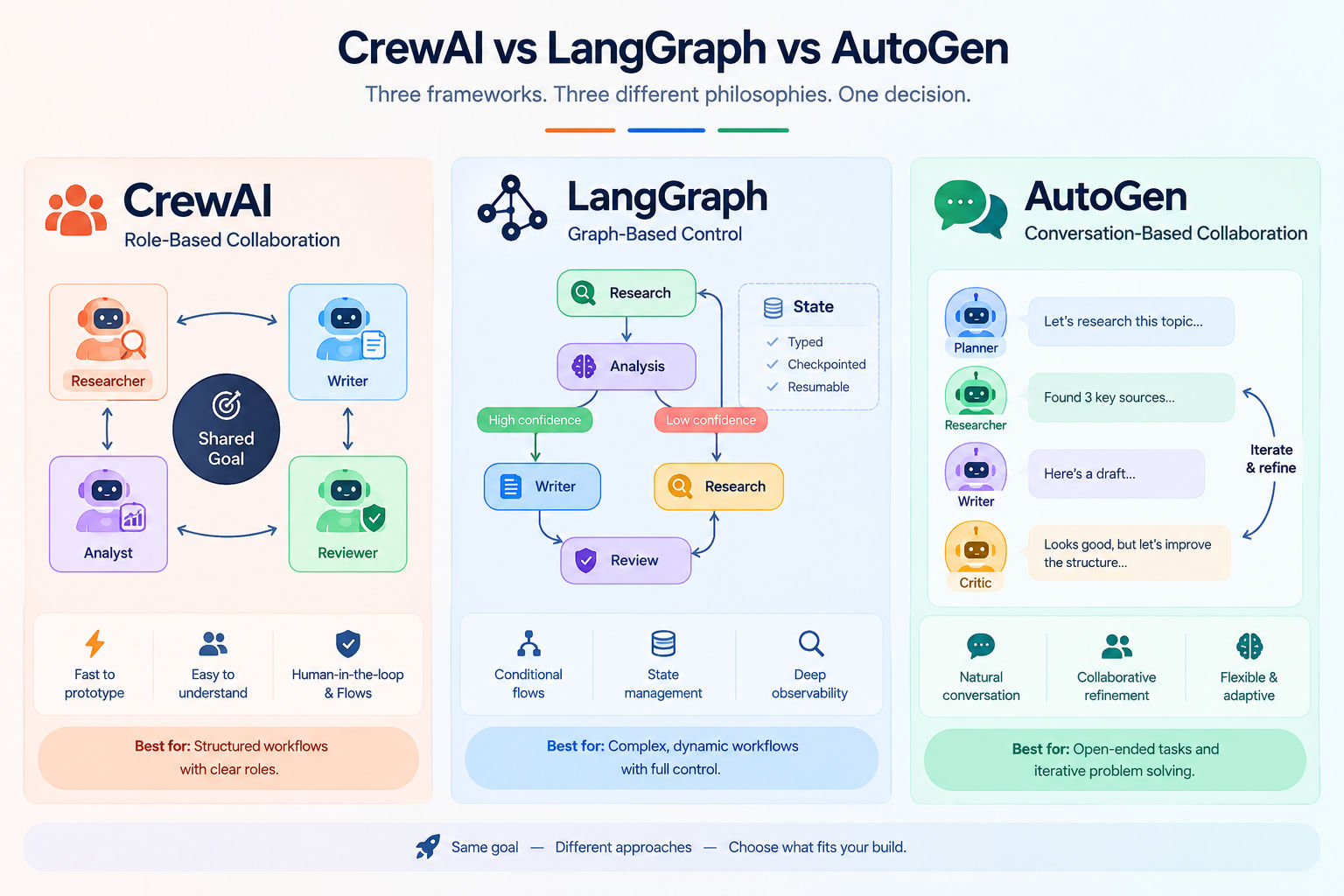
CrewAI's design philosophy is simple: what if building a multi-agent system felt like putting together a team? Each agent has a role, a goal, a backstory, and access to specific tools. You define tasks and assign them. The crew executes.
This works remarkably well for a surprisingly large category of workflows. Content pipelines where a researcher feeds a writer. Customer support triage where an intake agent routes to a specialist. Data workflows where a fetcher passes structured output to an analyst. The role metaphor is not just metaphor - it genuinely maps to how these workflows are structured.
What CrewAI does particularly well is speed to first working prototype. The abstraction layer is high enough that you can describe a meaningful multi-agent workflow in a modest amount of code. Non-engineers can read it and understand what is happening. Human-in-the-loop checkpoints - where a supervisor can review or modify agent output before the next step - are natively supported.
The Flows feature, added in recent versions, gives CrewAI significantly more production credibility. Flows are event-driven orchestration pipelines that sit on top of Crews - giving you conditional branching, state management, and structured execution logic that makes the framework viable for serious production deployments, not just demos.
LangGraph - Maximum Control Through Graph Architecture
LangGraph does not use the team metaphor. It uses a graph. Your workflow is a directed graph of nodes - each node is an agent, a function, or a decision point - connected by edges that define how execution flows between them. Those edges can be conditional, which is where LangGraph's real power lives.
Conditional edges mean your workflow can genuinely branch based on what happened at the previous node. An analysis agent produces output. If confidence is high, route to the writer. If confidence is low, route back to the researcher for another pass. If an error is detected, route to a fallback handler. This kind of adaptive logic is awkward to express in role-based systems but natural in a graph.
LangGraph's state management is its other major advantage. The graph state is typed - you define exactly what data lives in the state object - and it is checkpointed automatically. This means workflows can pause, resume, and recover from failures without losing context. For long-running or multi-session workflows, this is not a nice-to-have; it is a requirement.
Being part of the LangChain ecosystem gives LangGraph access to LangSmith - one of the best observability tools available for LLM applications. You can trace every agent action, every tool call, and every state transition in a live production system. When something goes wrong, you can see exactly why. This matters enormously when you are debugging a complex multi-agent workflow under real load.
AutoGen - When the Workflow Itself Is a Conversation
AutoGen, developed by Microsoft Research, starts from a different assumption entirely: what if the best way to coordinate agents is to let them talk to each other? Instead of roles or graphs, AutoGen models agent collaboration as natural language conversation - agents take turns, critique each other's outputs, build on previous responses, and refine their collective work through dialogue.
The RoundRobinGroupChat model is central to how this works. Multiple agents take turns responding, and every response is broadcast to the entire group - so all participants maintain shared context. This creates a natural review-and-revise dynamic that makes AutoGen particularly strong for iterative tasks: one agent drafts, another critiques, a human supervisor can step in at any point.
AutoGen also integrates naturally with the Microsoft Azure ecosystem, making it the most straightforward choice for teams that are already heavily invested in that infrastructure. Its ties to Microsoft Research mean it tends to be at the frontier of conversational agent research.
The honest limitation is consistency at scale. The conversational nature of the system means outputs can vary in structure and depth depending on how the conversation evolves. For workflows where output format consistency is critical, you need to invest in additional guardrails. Large-scale distributed deployments also require architecture work that LangGraph handles more natively out of the box.
Side-by-Side: CrewAI vs LangGraph vs AutoGen
| Dimension | CrewAI | LangGraph | AutoGen |
|---|---|---|---|
| Architecture | Role-based | Graph / node-edge | Conversational |
| Learning curve | Low - intuitive | Moderate - graph model | Low - conversational |
| Conditional logic | Limited | Native and powerful | Via conversation |
| Memory | Role-based + RAG | State graph + checkpointing | Conversation history |
| Human-in-the-loop | Checkpoints | Pause/resume hooks | By design |
| Production readiness | Good (with Flows) | Excellent | Growing |
| Observability | Moderate | LangSmith - excellent | LLM-level logging |
| Scalability | Agent replication | Distributed graph | Conversation sharding |
| Ecosystem | Growing community | Full LangChain | Microsoft / Azure |
| Best use case | Role-based pipelines | Complex adaptive systems | Review-heavy iterative work |
How to Choose - A Practical Decision Framework
Stop trying to pick the "best" framework in the abstract. The right framework is the one whose mental model matches the shape of your specific workflow. Here is how we think about it at GroveTech when advising clients:
- Choose CrewAI if you can describe your workflow as a team with clear roles. Researcher, Writer, Editor is a CrewAI workflow. Intuitive to prototype, easy for stakeholders to understand, good for structured business pipelines.
- Choose LangGraph if what happens next depends on what just happened, and if that dependency is complex. Adaptive decision pipelines, branching based on intermediate results, long-running workflows with state persistence - LangGraph is built for this. Our go-to recommendation for production enterprise deployments.
- Choose AutoGen if the workflow is genuinely iterative and conversational. Agents that debate, critique, and refine together. Workflows where humans participate meaningfully rather than just reviewing final output. Rapid exploration of novel agent interaction patterns.
These frameworks are not mutually exclusive. The most sophisticated production systems we build at GroveTech often use LangGraph as the orchestration backbone - because its state management and conditional execution are the most powerful - with CrewAI-style role patterns or AutoGen-style conversation loops embedded within specific nodes. If you want to see what this looks like in practice, visit our portfolio page or explore our AI development services. Ready to start building? Our step-by-step guide to building an AI agent covers the full process.
Enterprise and Production Considerations
When a prototype moves into production, the conversation changes. Accuracy in a demo matters. In a live system, you also need reliability, observability, cost control, and compliance. Here is how each framework performs on what actually matters at scale:
Observability. LangGraph wins here, and it is not close. LangSmith gives you complete trace visibility into every agent action, every LLM call, and every state transition. When a workflow misbehaves in production at 3am, LangSmith is the difference between knowing what happened and guessing. CrewAI and AutoGen offer logging, but nothing at this depth. Pairing agents with solid DevOps practices makes this even more effective.
Cost management. All three frameworks support caching - CrewAI caches tool results, LangGraph supports node-level caching with SQLite or in-memory backends, and AutoGen supports LLM-level caching with disk or Redis. In high-volume deployments, proper caching can reduce inference costs by 30-50%. Build it in from the start, not as an afterthought.
Compliance and security. All three frameworks delegate security to your infrastructure and LLM provider layer. However, LangGraph's typed state and checkpointing make it significantly easier to build audit trails and approval flows that compliance frameworks often require. AutoGen's Microsoft backing makes it the natural fit for organisations deeply embedded in Azure with enterprise security requirements.
If you want to see how GroveTech approaches these considerations in real client work, our portfolio includes examples across healthcare, fintech, and SaaS verticals, and you can browse the industries we serve. Our blog also covers production AI architecture in depth, including AI workflow automation, AI agent use cases, and AI agents vs chatbots.
Conclusion
CrewAI, LangGraph, and AutoGen are all capable frameworks - the real question is which one fits the shape of your workflow and the demands of your production environment. Start with the mental model that matches your problem, prototype quickly, and plan for observability and guardrails from day one.
Want help choosing and building? Book a free consultation with our AI engineering team.
Frequently Asked Questions
Common questions about CrewAI vs LangGraph vs AutoGen
CrewAI uses a role-based model - agents behave like employees with defined responsibilities. LangGraph uses a graph-based model - workflows are nodes and edges with conditional execution paths and typed state. AutoGen uses a conversational model - agents collaborate through natural language dialogue, making it ideal for iterative, review-heavy tasks. Each reflects a fundamentally different design philosophy.
Neither is universally better. CrewAI is better for structured, role-based workflows where the division of labour is clear and intuitive. LangGraph is better for complex workflows with conditional branching, dynamic adaptation, and production requirements like state persistence and deep observability via LangSmith. Many teams use LangGraph as the backbone with CrewAI patterns embedded within specific nodes.
Use AutoGen when the workflow is genuinely conversational and iterative - when the right answer emerges through agents critiquing and refining each other's work. It is also the most natural choice when humans need to participate meaningfully in the loop rather than just reviewing final output. Brainstorming, code review automation, collaborative research synthesis, and rapid prototyping of novel agent interactions are all strong fits.
CrewAI is the easiest starting point because the role-based metaphor maps directly to how most people think about dividing work among a team. AutoGen is also accessible due to its conversational setup. LangGraph has the steepest initial learning curve - graph-based thinking and typed state management require deliberate study - but it pays the largest dividends for complex production systems once mastered.
LangGraph is currently the strongest choice for complex enterprise production deployments, thanks to its distributed graph execution, typed state with checkpointing, LangSmith observability integration, and the mature LangChain ecosystem. CrewAI with its Flows feature is also increasingly production-ready for structured role-based workflows and is a strong choice for teams that prefer its more intuitive model.
Yes. GroveTech Solutions designs and builds production-ready multi-agent AI systems using CrewAI, LangGraph, AutoGen, and custom orchestration architectures. We assess which framework genuinely fits your workflow, integrate it with your existing systems, and deliver fully monitored, scalable deployments. See our work in the portfolio or get in touch directly for a free discovery call.
Sharad Patel
Software Engineer · GroveTech Solutions
A member of the GroveTech Solutions engineering team, passionate about building great software and sharing knowledge with the developer community.
Our Services


